4 APRIL 2025
PLEASE NOTE THAT OWING TO COPYRIGHT OR INTELLECTUAL PROPERTY PERMISSIONS WE ARE UNABLE TO SHARE RECORDINGS OF SOME SESSIONS
VIDEO: DAY 1 & 2 SUMMARY: Thilina Lalitharathe (Queen Mary University London, UK)
VIDEO: CONFERENCE CLOSING REMARKS: Fumiya Iida (University of Cambridge, UK)
FINAL PLENARY TALK
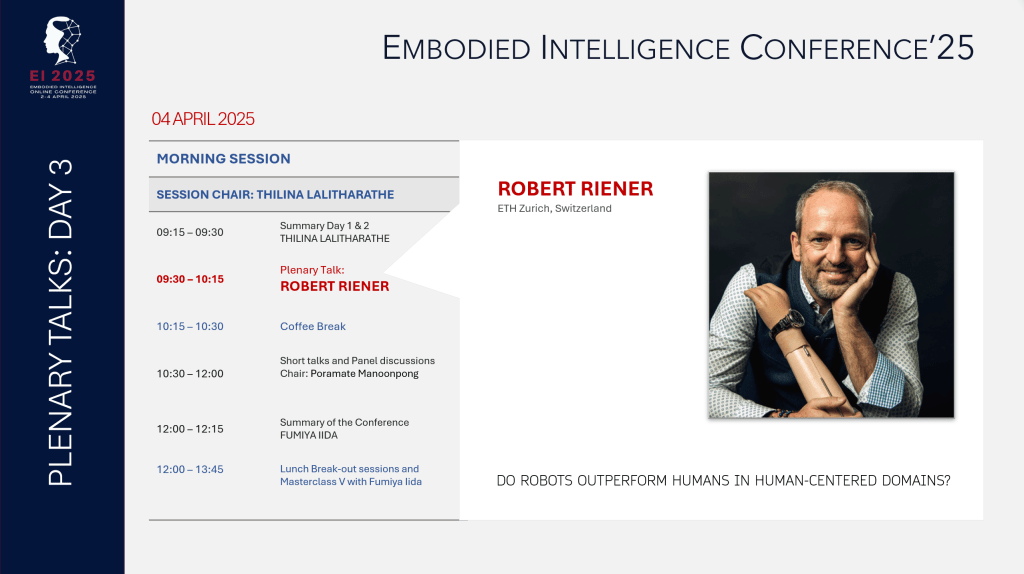
ROBERT RIENER (ETH Zurich)
VIDEO: DO ROBOTS OUTPERFORM HUMANS IN HUMAN-CENTERED DOMAINS?
Abstract: The incessant progress of robotic technology and rationalization of human manpower induces high expectations in society, but also resentment and even fear. This talk will present a quantitative normalized comparison of performance, to shine a light onto the pressing question, “How close is the current state of humanoid robotics to outperforming humans in their typical functions (e.g., locomotion, manipulation), and their underlying structures (e.g., actuators/muscles) in human-centered domains?” Most state-of-the-art robotic structures required for visual, tactile, or vestibular perception outperform human structures at the cost of slightly higher mass and volume. Electromagnetic and fluidic actuation outperform human muscles w.r.t. speed, endurance, force density, and power density, excluding components for energy storage and conversion. Artificial joints and links can compete with the human skeleton. In contrast, the comparison of locomotion functions shows that robots are trailing behind in energy efficiency, operational time, and transportation costs. Robots are capable of obstacle negotiation, object manipulation, swimming, playing soccer, or vehicle operation. Despite the impressive advances of humanoid robots in the last two decades, current robots are not yet reaching the dexterity and versatility to cope with more complex manipulation and locomotion tasks (e.g., in confined spaces). We conclude that state-of-the-art humanoid robotics is far from matching the dexterity and versatility of human beings. Despite the outperforming technical structures, robot functions are inferior to human ones, even with tethered robots that could place heavy auxiliary components off-board. The persistent advances in robotics let us anticipate the diminishing of the gap.

FINAL SHORT TALK SESSION (VIDEOS)
- Poramate Manoonpong: EMBODIED INTELLIGENCE IN SOFT ROBOTICS: FROM MORPHOLOGICAL TO NEURAL COMPUTATION
- Abstract: Soft-bodied crawling animals exhibit adaptive, emergent behaviors resulting from the synergy between morphological computation (e.g., a flexible soft body and anisotropic skin) and neural computation (e.g., neural control with synaptic plasticity and memory). However, realizing this synergy in robots remains challenging. In my talk, I will present our embodied neural control approach that integrates a flexible soft-body structure with asymmetrical abdominal denticles and an adaptive neural control system. The body structure, capable of micro- and macro-deformation, facilitates passive adaptation (achieved through morphological computation), while the adaptive neural control system generates locomotion patterns and enables online learning for active adaptation (achieved through neural computation). This two-level adaptation strategy allows a simple soft robot to passively adapt its body to small perturbations and actively adapt its control in response to larger perturbations. Our approach provides a possible option toward achieving embodied intelligence in soft robotics.
- An Qi: ACQUISITION OF EMBODIMENT IN CHILDREN’S REHABILITATION
- Abstract: Humans learn the relationship between sensory inputs and the musculoskeletal system throughout their development. Therefore, childhood disorders can significantly impair the acquisition of embodiment compared to disorders that occur in adulthood. In this talk, I will discuss what types of rehabilitation are crucial for the acquisition of embodiment in clinical settings, using children with cerebral palsy as an example.
- Ilana Nisky: A STRETCH AT YOUR FINGERTIPS: SKIN DEFORMATION INFORMS PERCEPTION AND AFFECTS ACTION
- Abstract: Our perception of the world and our actions within it are closely intertwined, and continuously shaped by sensory feedback. In this talk I will explore the complex relationship between tactile perception and action, highlighting insights from our recent research on how artificial tactile feedback influences stiffness perception and grip force control. In human psychophysical studies, we found that tactile stimulation—specifically artificial skin stretch—can augment perceptual judgments of object stiffness. Next, we investigated whether an artificial agent can infer perceptual information directly from action signals alone, without explicit stimulus information. Remarkably, we found that perceptual augmentation caused by artificial skin stretch could indeed be inferred from grip force and motion signals alone, without any information about the artificial stretch. This suggests that action signals inherently contain perceptual information, providing insight into another facet of embodied intelligence. I will discuss the implications of tactile information integration for embodied systems, emphasizing how understanding this interplay can advance the development of intelligent robotic and human-machine interfaces.
- Yuki Nakagawa: HUMANOID ROBOTS AND EMBODIED AI FOR HUMAN WORK
- Abstract: In recent years, the adoption of automation powered by AI and robotics has been rapidly progressing in food processing and mechanical component factories. Among these advancements, humanoid robots have garnered particular attention due to their ability to operate in human-oriented environments using the same tools and processes as human workers. This paper introduces real-world applications of humanoid robots deployed in industrial settings and examines the challenges and technical requirements they face. Emphasis is placed on the necessity of Embodied AI—intelligence that is tightly coupled with physical interaction capabilities—for situational awareness, flexible decision-making, and adaptive motor control in complex environments.
- The paper also explores the future direction of humanoid robots toward achieving autonomous operation and seamless human–robot collaboration.
- PANEL DISCUSSION
<DAY 3 IMAGES: CLICK TO ENLARGE>
 Embodied Intelligence